An LLM-assisted reporting product I designed to turn validated operational data into consistent executive briefs, donor narratives, risk summaries and action recommendations while keeping governance, source context and human review in the workflow.
70%+Target reduction in repetitive first-draft reporting effort.
5Reporting outputs: briefs, trends, anomalies, forecasts and recommendations.
GovernedAccess control, auditability, business rules and compliance by design.
HumanReviewer remains responsible before reports are shared or escalated.
The Business Problem
Many teams already have dashboards, spreadsheets and operational systems, but leadership still waits for someone to translate the numbers into a clear story. That translation work is often manual: collect the data, compare movement, explain variance, identify risk, draft commentary and prepare a final brief.
The issue is not only time. Manual reporting can introduce inconsistent interpretation, missed drivers and weak linkage between numbers and recommended action.
The product question was simple: can reporting teams move faster without losing evidence, consistency or review control?
What I Built
I designed a reporting workflow where validated operational data is prepared, modelled, checked against business rules and passed into an LLM orchestration layer that produces structured narratives. The output is not treated as final truth. It becomes a reviewable first draft with source context, KPI movement, anomaly notes, risks and proposed management actions.
The system is positioned as an intelligence reporting assistant: it helps users ask natural-language questions, produce report drafts on demand and create repeatable management summaries across recurring reporting cycles.
Solution Architecture
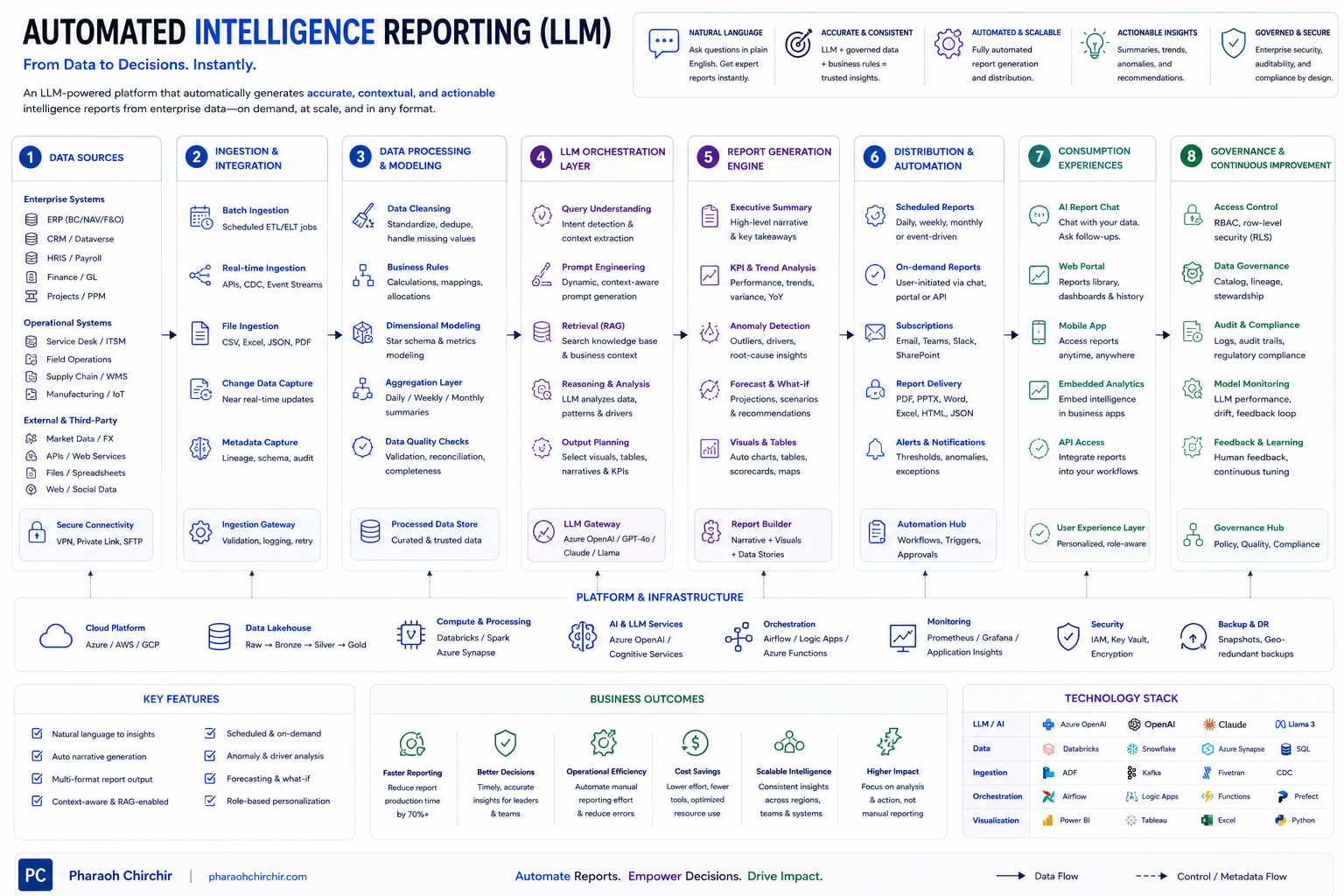
The architecture separates ingestion, data modelling, retrieval, prompt orchestration, report generation, distribution and governance. This makes it easier to explain where data enters, where business logic is applied, where the LLM contributes and where human review remains mandatory.
Architecture view: enterprise data sources, processing, retrieval, LLM orchestration, report generation, distribution channels and governance controls.
The Decision Flow
The workflow begins with structured data from enterprise, operational and external sources. Data is cleaned, aggregated and modelled into a trusted reporting layer. The reporting engine then combines business rules, retrieval context and prompt templates to produce narratives that are aligned to KPIs, time movement and known exception logic.
Instead of asking an AI model to invent insight, the design narrows the task: summarize what changed, explain likely drivers, flag anomalies, recommend next steps and preserve enough context for review.
Why This Matters
For executives, the value is speed and consistency. For analysts, the value is moving from repetitive draft preparation into review, validation and interpretation. For operations teams, the value is faster visibility into risks that need action.
The strongest use cases are recurring performance packs, donor updates, regional operating briefs, exception reporting, board summaries and management commentary for Power BI or data-platform outputs.
Controls And Governance
The architecture includes access control, data governance, audit trails, role-level security, monitoring and feedback loops. That is important because automated reporting becomes risky when people cannot tell what data was used, what logic shaped the summary or whether the output was reviewed.
My design keeps the LLM inside a controlled reporting workflow rather than making it the owner of the business decision.
Power BI And Analytics Fit
This project connects naturally to BI work because the LLM layer is only useful when the data model below it is trusted. Semantic models, data quality checks, KPI definitions, dimensional modelling and business rules create the ground truth. The AI layer helps explain and distribute that truth faster.
The Value In One Sentence
Automated Intelligence Reporting demonstrates how I turn reporting from a manual writing cycle into a governed decision-support workflow where data, business rules, AI assistance and human review work together.