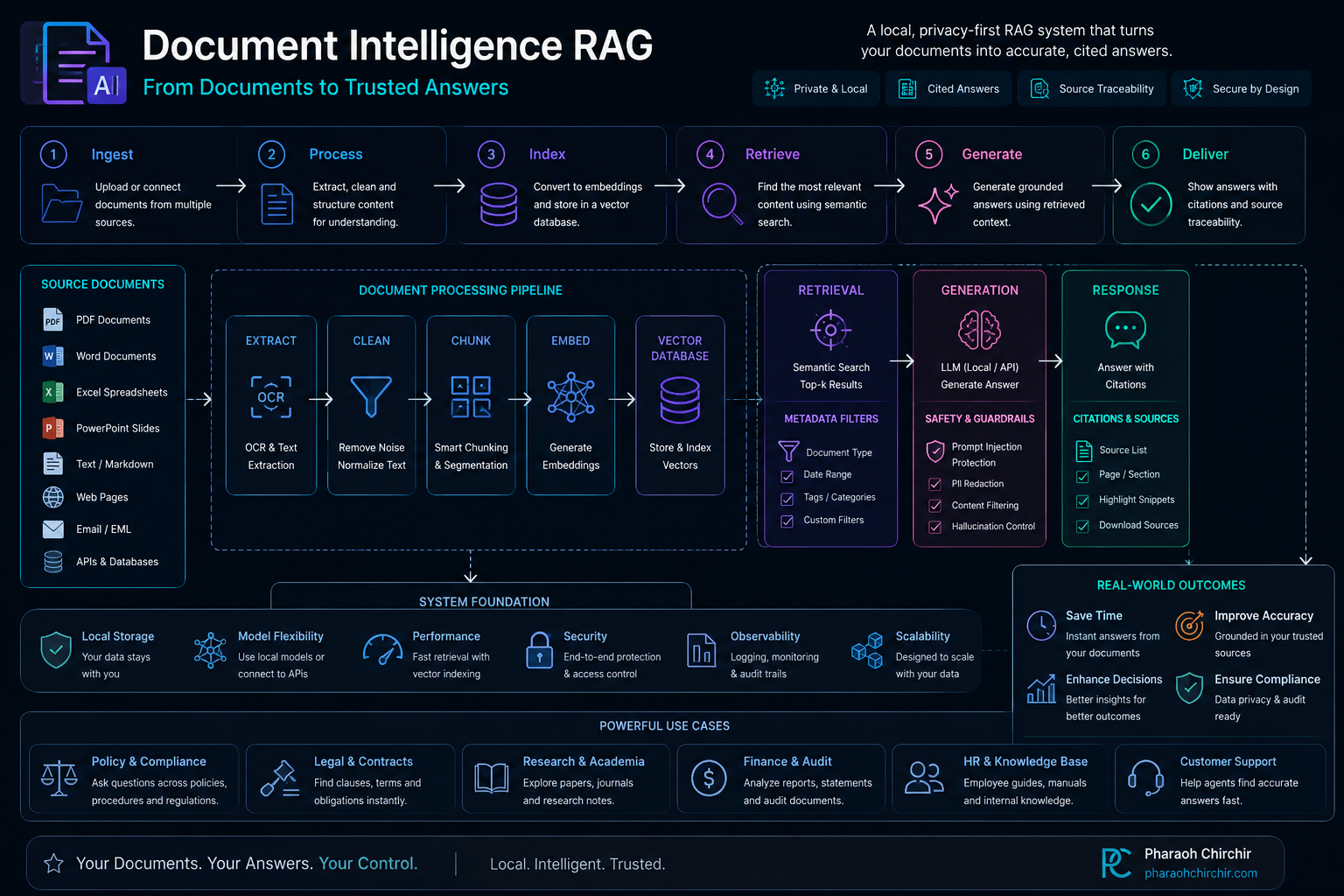
I designed a document intelligence workflow that turns long reports, agreements, policy notes and operational files into searchable evidence, structured extraction and reviewable actions.
RAGAnswers are grounded in provided document context.
92%Straight-through processing pattern in workflow demo.
500+Documents per day pattern simulated for operations.
SLASame-hour routing and exception handling logic.
The Document Problem
Document-heavy teams often have the information they need, but it is locked inside reports, agreements, evaluations, policy notes, case files and operational attachments. The cost is not only time spent reading. It is missed evidence, inconsistent interpretation, delayed routing and weak auditability.
The product question was not whether AI could summarize a document. The question was whether the workflow could help a team find the right evidence, extract the right fields and decide what should happen next without pretending that every answer is certain.
The business value is a faster route from document evidence to a reviewable decision.
The Challenge
Document AI can look impressive while still being operationally risky. A fluent answer without source grounding is difficult to trust. An extraction without confidence handling can push errors downstream. A routing decision without human-review logic can create hidden risk.
I designed the case study around those practical constraints: retrieval must stay scoped to the uploaded or selected document context, extracted fields must be understandable, and low-confidence or sensitive cases should move to review instead of being treated as complete.
The Product Question
I framed the solution around one question:
Can document AI reduce manual reading burden while preserving traceability, review and decision control?
This shifted the design away from a generic chatbot and toward a document operations workflow: ingest, retrieve, extract, classify, route, review and export.
My Role
I designed the workflow, demo logic, document Q&A experience, extraction patterns, confidence scoring, exception routing and reviewer-facing outputs. I also shaped the interface around how business users actually inspect documents: ask a question, verify the evidence, review extracted fields and decide the next action.
Solution Architecture
The architecture separates document ingestion, retrieval, extraction and routing so that each layer can be tested and improved independently.
Ingest and prepare Accept reports, agreements, notes or sample files and prepare text for retrieval and review.
Document context Searchable content with preserved source boundaries.
Retrieval
Find relevant evidence Match the user question to document passages instead of answering from open-ended memory.
Grounded answer Response supported by retrieved document context.
Extraction
Structure the facts Identify fields, dates, parties, obligations, risks, exceptions and action items.
Reviewable fields Structured output that users can inspect before use.
Controls
Score and route Apply confidence, exception and sensitivity logic before marking work complete.
Human review Low-confidence or sensitive items stay visible.
Action layer
Summarize and export Create summaries, queues and decision records for downstream users.
Operational output Evidence-backed action, not just generated text.
RAG Workflow
The RAG workflow is designed to keep the answer close to the selected document. A user asks a question, the system retrieves relevant passages, then the answer is formed around that retrieved context. This makes the answer easier to challenge because the user can inspect what the system used.
The important behaviour is scope control. If the answer is not supported by the document context, the assistant should avoid guessing and guide the user back to the document evidence.
Extraction And Routing
The workflow also demonstrates structured extraction. Instead of giving only a summary, it can surface key details such as document type, parties, deadlines, obligations, risk flags, missing information and recommended next step.
Routing logic then separates clean items from exceptions. A high-confidence routine item can move forward. A missing field, conflicting statement or sensitive issue can move into review.
Human Review And Confidence
The case study treats confidence as a workflow signal rather than a decoration. A confidence score is useful only if it changes what happens next. The design therefore uses confidence to decide whether an output is ready, needs a reviewer or requires more context.
Document AI is stronger when uncertainty is visible and review is part of the product.
Use Cases
Operations
Teams can inspect field reports, incident narratives or operational notes faster and turn recurring issues into structured action.
Compliance And Governance
Reviewers can search policy documents, agreements and evidence packs while keeping source context visible.
Programme And Evaluation Work
Analysts can summarize bulky evaluation material, extract themes and route exceptions without losing traceability.
What The Project Demonstrates
The project demonstrates document-scoped Q&A, extraction, confidence handling, review routing, SLA-style decision logic and a practical AI workflow that is easy for non-technical users to understand.
It also shows how AI can be positioned as a decision-support layer rather than an uncontrolled answer machine.
What It Does Not Prove
I designed this workflow to demonstrate document intelligence patterns. It does not claim legal review accuracy, clinical validity, regulatory approval or guaranteed extraction performance across all document types.
Those claims would require labelled test data, accuracy evaluation, reviewer sign-off and production monitoring.
Production Path
A production version would add secure document storage, access control, audit logging, reviewed extraction schemas, evaluation datasets, source citations, reviewer queues, exception dashboards and integration into business systems such as CRM, document management or case-management platforms.
The strongest evidence is the working demo path: users can open the RAG demo, inspect document-scoped responses, then open the workflow demo to see extraction, routing and review logic.