I built a people analytics product that turns HR records into workforce KPIs, attrition risk, pay-equity checks, headcount forecasting and guided decision support.
HR teams are often asked to explain workforce risk after the problem has already become visible: attrition has increased, hiring is late, departments are understaffed or pay concerns have reached leadership level.
The product question was how to turn ordinary HR records into an early-warning analytics layer that helps teams see patterns, explain risk and prepare interventions before issues become expensive.
The value is not a colourful HR dashboard. The value is earlier action on retention, headcount, pay equity and workforce planning.
The Challenge
People data is sensitive, messy and easy to misread. A useful HR analytics product needs to show patterns without exposing unnecessary personal detail, support uploaded datasets, and keep outputs explainable enough for HR, finance and leadership review.
The demo therefore focuses on privacy-aware summaries, role and department trends, risk bands, forecast direction and local AI-style questions that do not require sending uploaded data to an external service.
The Product Question
I framed the platform around one question:
Can HR data become a guided decision product for retention, workforce planning and pay-equity review?
This shaped the solution into modules for dashboarding, prediction, exploration, local AI and export-ready evidence.
My Role
I designed the analytics workflow, sample HR data structure, filtering logic, predictive modules, local AI question patterns, dashboard experience and Cloudflare-safe browser adaptation.
This shows how I convert a Python analytics concept into a product experience that non-technical users can inspect and test.
Solution Architecture
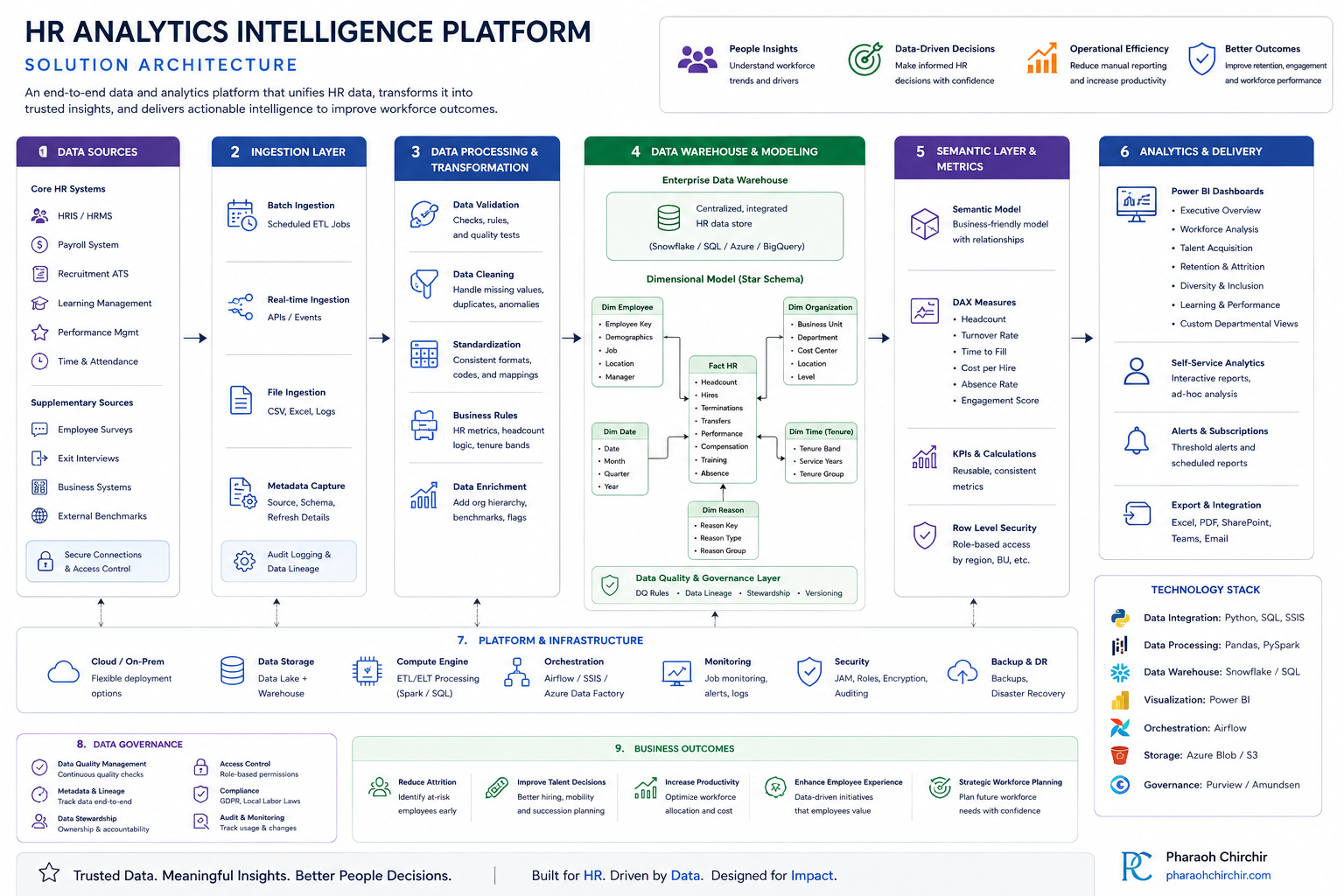
The architecture is designed around a practical HR workflow: load data, profile it, filter it, generate insights, predict risk, explore relationships and export action-ready outputs.
Architecture view: HR data sources, ingestion, modelling, semantic measures, analytics delivery, governance and workforce outcomes.
HR data
Load and profile Use sample or uploaded CSV data and detect useful HR fields.
Analysis-ready dataset Workforce records prepared for dashboarding.
Dashboard layer
Filter and summarize Show headcount, tenure, salary, department and location patterns.
Workforce visibility Leaders can inspect core HR signals.
Predictive layer
Score and forecast Estimate flight risk, headcount direction and pay-equity indicators.
Risk view Teams can prioritize review and intervention.
Local AI
Ask data questions Match HR questions to fields, tables and chart-ready answers.
Guided exploration Users can inspect data without code.
Action output
Review and export Prepare risk queues and selected data for follow-up.
HR action Analytics becomes planning evidence.
Modules Included
The platform includes an executive HR dashboard, predictive analytics, exploratory analysis, Local AI and an optional advanced AI path for hosted environments. Each module supports a different decision moment: understand, predict, explore, ask and act.
Privacy And Responsible Use
I use synthetic data in this demo and avoid exposing unnecessary personal information. The local assistant pattern lets visitors see how HR questions can be interpreted without sending uploaded data to external services.
In a production HR setting, the same design would require role-based access, data minimization, audit logging and clear governance over sensitive fields.
Decisions Enabled
The platform helps HR and management teams identify attrition risk, inspect workforce composition, monitor pay patterns, forecast headcount pressure and prepare evidence for retention or hiring decisions.
It also helps analysts move from static reports to interactive workforce exploration.
What It Does Not Prove
I use synthetic data and demonstration logic in this public version. It does not claim production HR model accuracy, legal pay-equity certification or validated attrition outcomes.
Those claims would require real historical HR data, fairness review, model validation and controlled business evaluation.
Technology
Core skills: HR analytics, attrition prediction, dashboard UX, workforce planning, data privacy and local AI-style question handling. Typical stack: Python analytics patterns, browser-based Cloudflare sandbox, CSV upload, rule-based insights and export-ready tables.
Evidence
The live demo lets visitors load sample HR data, upload compatible datasets, review workforce KPIs, run predictive modules and ask local data questions.