I built a forecasting workflow that helps planners connect demand history, stock position, lead time and service targets into clear replenishment decisions.
18%Demo MAPE pattern for forecast error monitoring.
120SKU planning pattern represented in the demo.
PlanReplenishment actions generated from forecast logic.
ExportPlanner outputs can move into follow-up action.
The Planning Problem
Supply teams are constantly balancing two risks: stockouts that disrupt service and overstock that locks up cash, storage and transport capacity. The decision becomes harder when demand shifts by SKU, warehouse, season, client and lead time.
The goal was to show how a forecasting product can help planners move from historical sales or consumption records to practical replenishment action.
The value is not forecasting for its own sake. The value is knowing what to reorder, where risk is rising and which decision needs attention now.
The Challenge
Forecasting can become too technical for the people who need to act on it. A planner needs to see forecast direction, inventory cover, reorder point, service risk and recommended action without decoding model internals.
I designed the demo around that decision path: load demand patterns, run forecast scenarios, compare drivers, identify risk and export actions.
The Product Question
I framed the project around one question:
Can SKU-level data become a replenishment decision workflow that reduces stockout and overstock pressure?
This shaped the interface around forecast simulation, inventory risk, planner questions and action queues.
My Role
I designed the forecasting workflow, sample data logic, scenario controls, dashboard layout, risk bands, assistant prompts and planner action outputs. This project shows my approach to predictive analytics, supply-chain thinking and decision-product design.
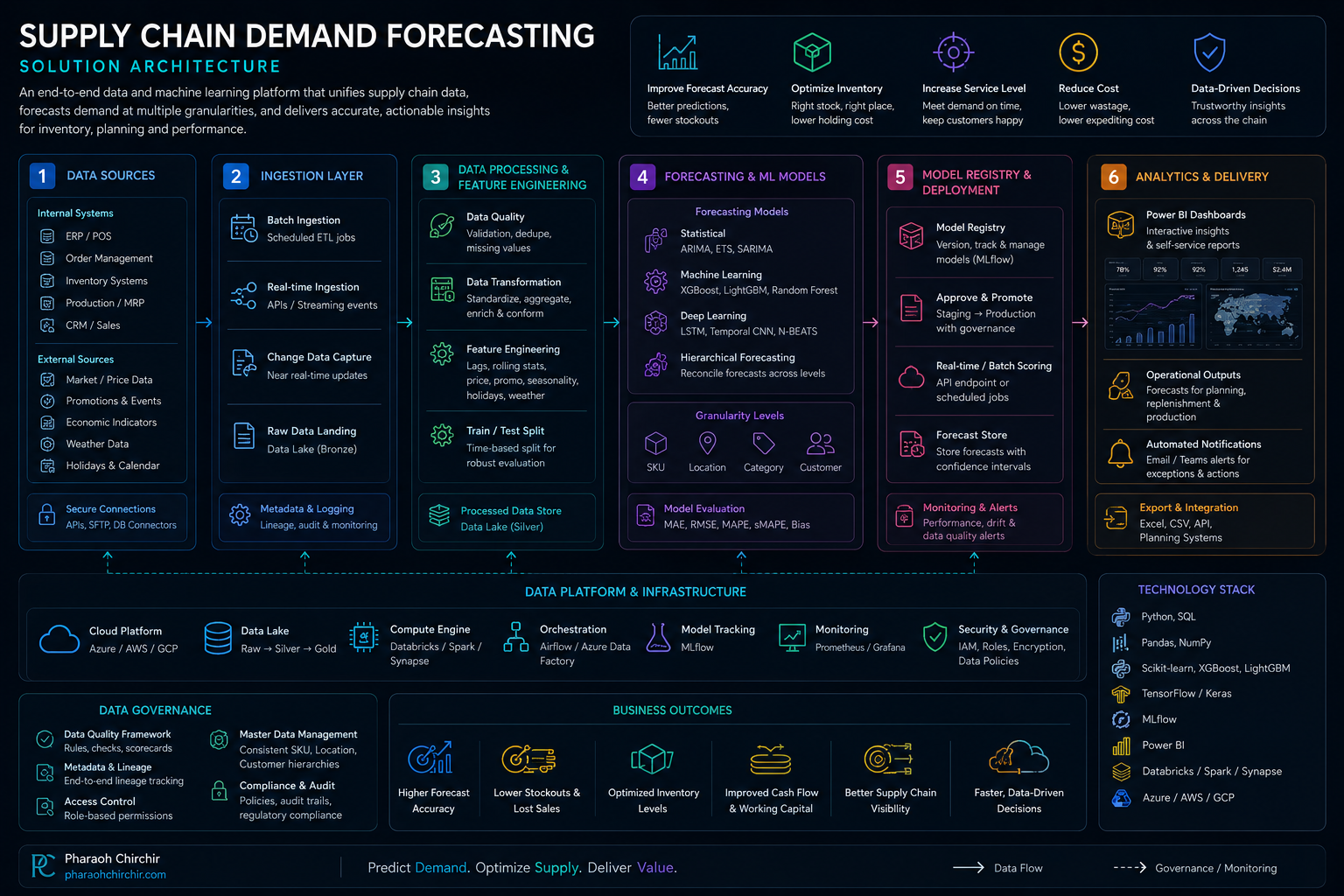
Solution Architecture
The solution connects demand history and inventory context into a planning layer that is easy to inspect and adjust.
Architecture view: supply chain sources, processing, forecasting models, model deployment, analytics delivery and decision outcomes.
Demand data
Prepare history Organize SKU, warehouse, date, demand, stock and lead-time signals.
Planning base Clean demand series for forecast review.
Forecast layer
Run scenario Estimate future demand and compare forecast bands.
Expected demand Forward-looking view by SKU and site.
Inventory logic
Check service risk Compare stock, lead time, forecast and service targets.
Risk bands Stockout, healthy cover or overstock signal.
Action queue
Prioritize decisions Rank SKUs by urgency and recommended replenishment action.
Planner output What to review, reorder or adjust.
Export
Hand off action Export the selected recommendations for planning follow-up.
Operational use Analytics supports procurement and distribution planning.
Use Cases
Retail And Distribution
Reduce shelf stockouts while avoiding excess seasonal inventory.
Logistics And Warehousing
Use forecast patterns to plan loads, capacity and replenishment timing.
Humanitarian And NGO Operations
Pre-position essential supplies more confidently for field programmes and donor-led distributions.
Decisions Enabled
The workflow helps users decide which SKUs are at risk, which locations need replenishment, where stock cover is excessive, and how forecast changes affect service continuity.
It turns forecasting from a technical model output into a planning conversation.
What It Does Not Prove
This is a portfolio demo using synthetic sample data. It does not claim production forecast accuracy for a real company, guaranteed stockout reduction or optimized procurement savings.
Those claims would require historical production data, back-testing, planner adoption metrics and before-after operational measurement.
Technology
Core skills: demand forecasting, inventory analytics, scenario design, dashboard UX, export workflows and planning decision support. Typical stack: Python analytics patterns, browser-based sandbox logic, CSV-ready data and Power BI-style visual design.
Evidence
The live demo lets visitors run forecast scenarios, inspect inventory risk and review planner-ready actions.