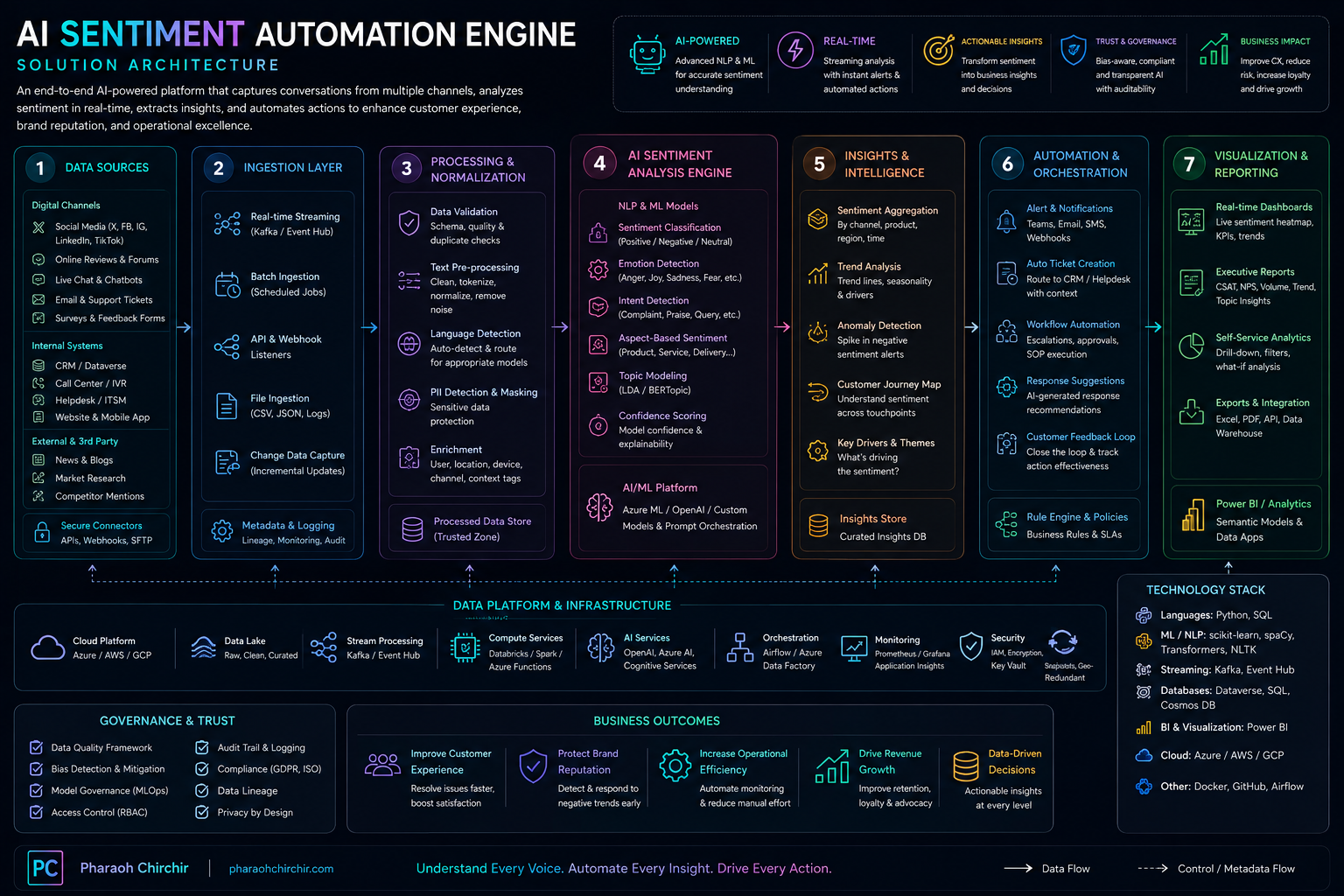
An AI workflow I designed to convert feedback, reviews, tickets and message streams into sentiment classification, topic signals, business actions and dashboard-ready intelligence.
3Core sentiment labels: positive, neutral and negative.
MultiFeedback inputs from reviews, tickets, chat and survey-style data.
Real-timeDesigned for fast classification and action routing.
BI-readyOutputs structured for dashboards, exports and trend analysis.
The Business Problem
Organizations collect large volumes of customer, employee, beneficiary and operational feedback, but much of it remains locked inside free-text comments, emails, tickets, reviews and chat logs. Teams often know there is signal in the text, but they cannot classify it quickly enough to respond at scale.
The result is delayed action: complaints take longer to surface, recurring issues are missed and reporting teams rely on anecdotal summaries instead of structured insight.
The problem is not collecting feedback. The problem is converting it into timely business action.
What I Built
I built a sentiment automation workflow that receives text from multiple channels, normalizes it, classifies sentiment, identifies intent and topics, stores the result and prepares the output for dashboards, alerts and action queues.
The product is designed to support service teams, customer experience teams, programme teams and operations leaders who need to understand what people are saying without manually reading every record.
Solution Architecture
The architecture shows how text moves from digital channels and internal systems through ingestion, processing, NLP classification, insight generation, workflow automation and Power BI-style reporting. Governance controls are included so privacy, bias review and auditability are treated as core requirements.
A text record enters the system from a channel such as a ticket, review, survey or chat. It is cleaned, language-checked and prepared for classification. The model then produces sentiment and related signals such as intent, topic and confidence.
Those signals are not left as model output only. They are converted into business outputs: dashboards, alerts, escalation suggestions, response queues and exportable datasets for deeper analysis.
Where It Creates Value
For customer experience teams, the system helps detect negative feedback early and track recurring pain points. For operations teams, it highlights service patterns that need intervention. For leadership, it turns scattered text into measurable themes, trend lines and action priorities.
The same pattern can support contact centres, service desks, insurance claims feedback, product reviews, programme feedback and internal employee listening.
Trust And Governance
Sentiment systems can fail when they treat language as simple positive or negative labels. This design keeps governance visible: data-quality checks, sensitive-text handling, audit logging, model monitoring and human review for high-impact actions.
The aim is not to automate empathy. The aim is to make high-volume feedback easier to understand, prioritize and act on responsibly.
Analytics And Reporting Layer
The product connects AI classification to BI reporting. Structured outputs can feed sentiment trend dashboards, channel performance reports, topic heatmaps, response-time views and executive summaries.
This is where the project shows the blend of AI development and analytics delivery: model outputs become a usable decision product.
The Value In One Sentence
AI Sentiment Automation Engine demonstrates how I turn unstructured text into governed sentiment intelligence, clear operational actions and reporting outputs that teams can use.