War Room Process Map
The War Room is an analytics intelligence pipeline. It starts by identifying the reviewer, then moves through evidence, transformation, communication, simulation, analyst judgement and deployment readiness.
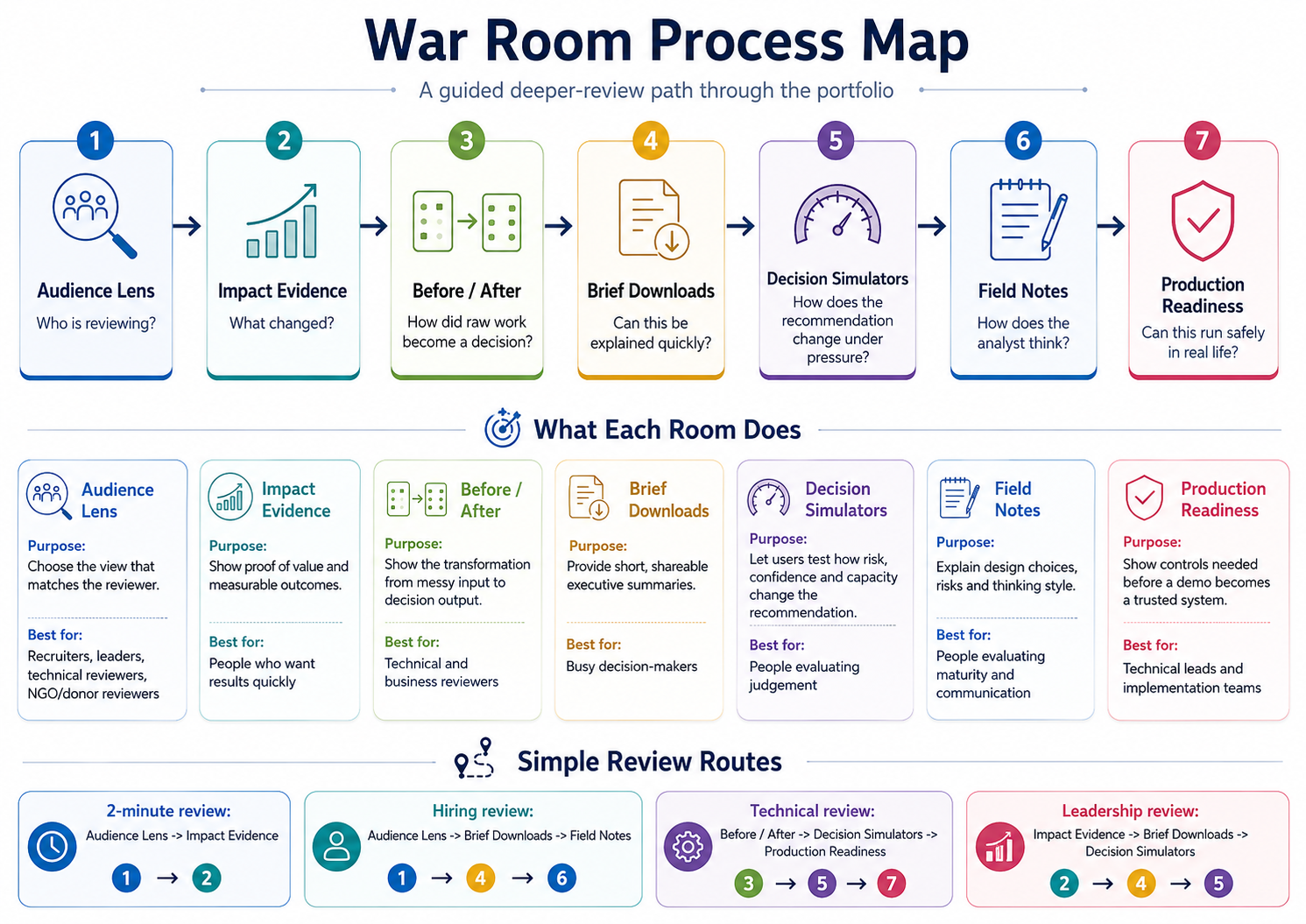
Pipeline Sequence
This replaces the Mermaid markdown with a responsive process diagram that can be read directly in the browser.
What Each Room Does
Choose the review angle that matches the person evaluating the work.
Best for: recruiters, leaders, technical reviewers and NGO/donor reviewers.
Show proof of value using measurable outcomes and operating results.
Best for: people who need results quickly.
Show the transformation from messy input to clean model, dashboard and decision output.
Best for: technical and business reviewers.
Provide short, shareable summaries for executive review.
Best for: busy decision-makers.
Let users test how risk, confidence and capacity change the recommendation.
Best for: people evaluating judgement.
Explain design choices, risks and the analyst's thinking style.
Best for: people evaluating maturity and communication.
Show controls needed before a demo becomes a trusted operating system.
Best for: technical leads and implementation teams.
Review Routes
Audience Lens -> Impact Evidence
Audience Lens -> Brief Downloads -> Field Notes
Before / After -> Decision Simulators -> Production Readiness
Impact Evidence -> Brief Downloads -> Decision Simulators