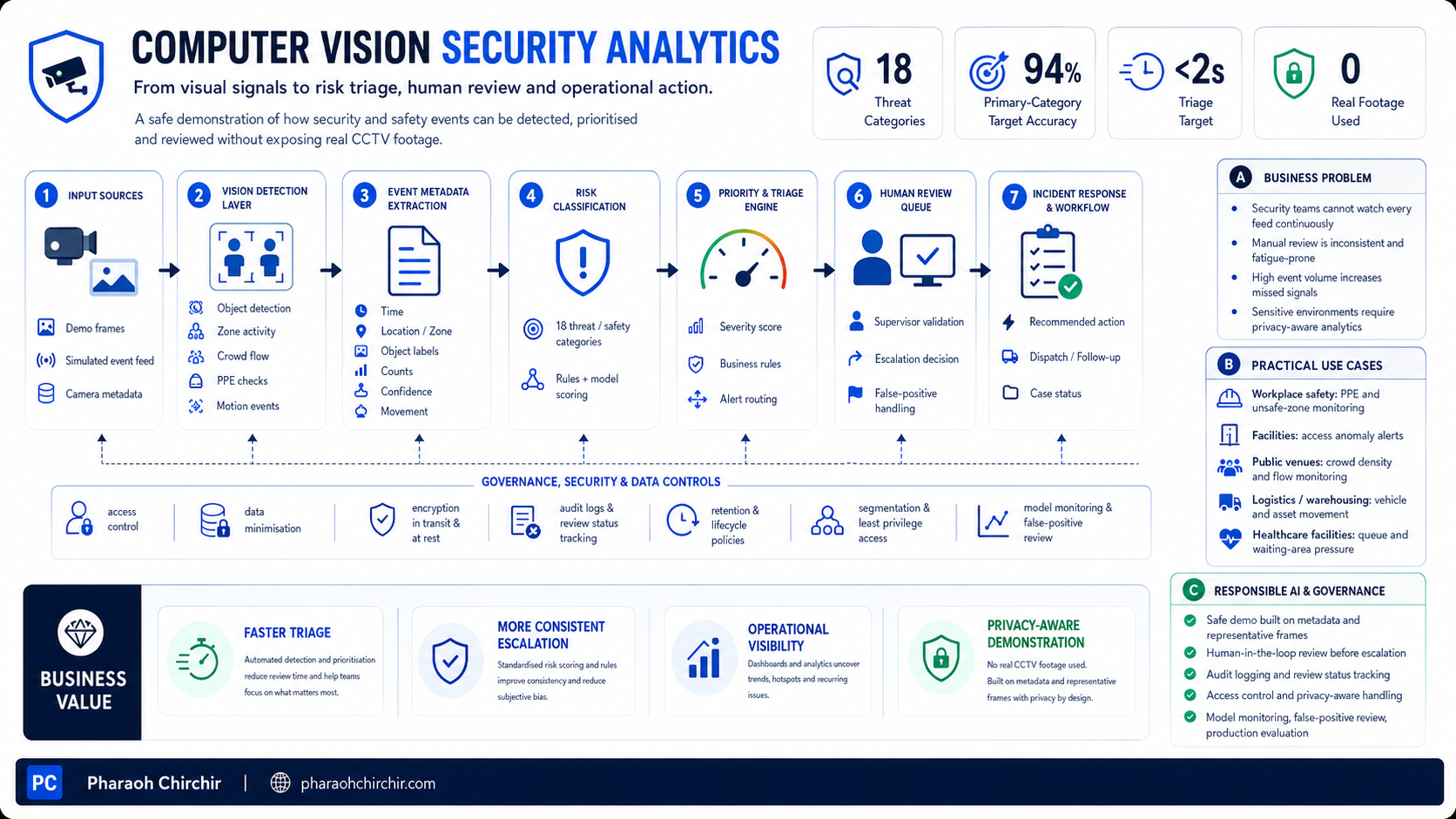
A privacy-aware security analytics prototype I designed to show how visual signals can be converted into risk triage, supervisor review and operational action without exposing real CCTV footage.
18Threat and safety categories modelled for event classification.
94%Primary-category target accuracy for demonstration scenarios.
<2sTarget triage response for simulated event scoring.
0Real footage used in the privacy-aware demo environment.
The Business Problem
Security operations teams receive more visual information than people can continuously monitor with consistent attention. When the volume is high, important signals can be missed, review quality can vary and escalation depends too heavily on manual judgement under pressure.
The challenge is to help supervisors focus on the events that matter most while preserving human validation before any operational response is triggered.
The goal is not to replace the security team. The goal is to reduce missed signals and make review more consistent.
What I Built
I built a safe demonstration of a computer-vision security workflow that receives representative event frames and camera metadata, extracts event features, classifies risk, prioritizes the queue and presents the result for human review.
I designed the solution around responsible security analytics: no real CCTV footage, no unmanaged automatic enforcement and no hidden decision logic. The supervisor remains the escalation point.
Solution Architecture
The architecture shows how camera metadata and simulated visual signals move through detection, metadata extraction, risk classification, priority scoring, review and incident response. Governance controls sit beneath the workflow so data handling, access and false-positive review remain part of the product.
Architecture view: input sources, vision detection, event metadata extraction, risk classification, triage, human review and incident response workflow.
The Decision Flow
An event enters the system with demo frame context and metadata such as location, time, zone, detected objects, movement and confidence. The model layer identifies possible event categories, while business rules help turn those signals into a risk score.
The output is then routed to a review queue where a supervisor can validate, downgrade, escalate or mark the event as a false positive. This makes the system operationally useful because it connects detection to accountability.
Where It Creates Value
The strongest use cases are environments where monitoring workload is high and response consistency matters: workplace safety, access anomaly detection, public venue crowd monitoring, logistics yards, warehouses and healthcare facility queues.
In each case, the value is faster triage, better visibility into recurring risk patterns, more consistent escalation and better evidence for operational improvement.
Responsible AI And Governance
Security AI needs stricter boundaries than ordinary analytics. The demonstration is built around privacy-aware data handling, access control, retention thinking, audit logs, segmentation of permissions and human review before escalation.
That design choice matters because a high-confidence detection should still be reviewed in context. The dashboard is a decision-support layer, not a final authority.
Analytics And BI Layer
The project also demonstrates BI thinking. Detection events are not valuable if they remain isolated alerts. They become more useful when aggregated into incident trends, location hotspots, category mix, response queues, false-positive monitoring and management reporting.
The Value In One Sentence
Computer Vision Security Analytics demonstrates how I design security AI as an operational decision product: visual signal detection, risk scoring, human review, governance and reporting in one controlled workflow.