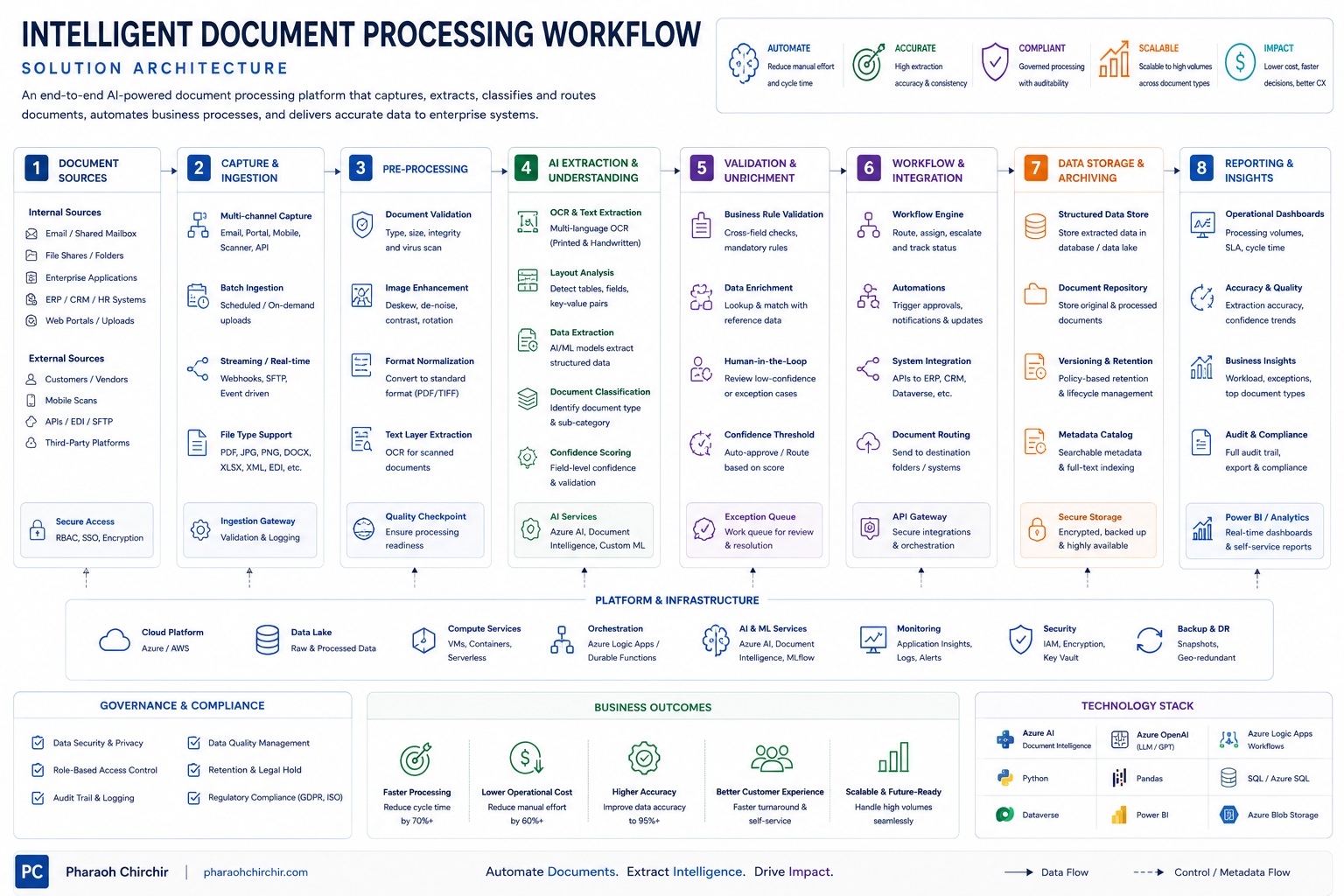
An AI-assisted document workflow I designed to capture, classify, extract, validate and route documents so teams can reduce manual effort while keeping exception review and auditability in place.
92%Straight-through processing pattern for routine document types.
500+Documents per day represented as high-volume workflow scenario.
95%+Target extraction accuracy for approved structured fields.
AuditEvery document moves through status, confidence and review controls.
The Business Problem
Document-heavy teams often lose time at intake: opening files, classifying document type, extracting fields, checking completeness, routing to the right person and tracking review status.
The bottleneck becomes expensive when the same document patterns appear every day. Staff spend time on routine extraction instead of exceptions, decision review and customer or beneficiary follow-up.
The goal is not to remove human review. The goal is to reserve human review for the documents that actually need it.
What I Built
I built a document-processing workflow concept that receives documents from multiple channels, checks quality, extracts text and fields, classifies document type, applies business validation and routes each case based on confidence and required action.
The demo shows how an AI-enabled workflow can support insurance claims intake, NGO field-report processing, government case-document triage, compliance review and customer document submission processes.
Solution Architecture
The architecture moves documents from intake through pre-processing, AI extraction, validation, workflow integration, storage and reporting. Governance and compliance controls sit across the process so document handling remains traceable and secure.
A document enters through email, upload, portal, scanner or API. The system checks file type and quality, extracts text where needed, identifies the document category and captures structured fields.
Business rules then validate mandatory fields and cross-field consistency. High-confidence routine cases can continue automatically. Low-confidence or exception cases move to a human review queue with the reason clearly visible.
Where It Creates Value
For insurance, it can accelerate claims intake and policy-document checks. For NGOs, it can structure field reports and supporting evidence. For government or migration-style workflows, it can triage case documents while preserving review status. For compliance teams, it can support extraction, indexing and audit trails.
Controls And Governance
The workflow includes role-based access, data security, audit logging, retention thinking, validation rules, confidence thresholds and exception queues. These controls matter because document automation becomes risky when extraction results are accepted without review logic.
Analytics And Reporting Layer
The workflow does not end at extraction. It produces operational dashboards showing processing volume, SLA, cycle time, accuracy, exceptions, top document types and audit status. That turns document automation into a management product, not just a back-office script.
The Value In One Sentence
Intelligent Document Processing Workflow demonstrates how I design AI automation that reduces manual document handling, improves processing visibility and keeps human review where judgement is required.